
Here is how I used the hassle-free Lisboa Card to explore Lisbon on my own. The Lisboa Card is a 3-in-1 transport card, museum pass and discount card. It offers free admission to 26 attractions and museum, discount on tours and participating stores, and free unlimited public transport including free travel by train to Sintra and Caicais!

Belem is a district in western Lisbon which is located at the mouth of River Tagus. Belem houses two famous landmarks of Lisbon: Jeronimos Monastery and Belem Tower (both are UNESCO World Heritage Sites). You can easily spent half day in Belem since it is a bit far from downtown Lisbon.

Sintra is a town nestled in the scenic Sintra mountains which is located about 28 km away northwest of Lisbon. Listed as a UNESCO World Heritage site, Sintra has many attractions that are worth visiting including Pena Palace and Park, Moorish Castle, Quinta da Regaleira, Sintra (National) Palace, Monserrate Palace and etc. It is possible to make a day trip to Sintra from Lisbon along with a stopover at Cabo da Roca (the westernmost point of continental Europe) and Cascais (a coastal resort town in Lisbon).

Quinta da Regaleira is an extravagant mansion in Sintra but the real gem is the garden with secret passages, mythological symbols and a Knights of Templar initiation well. Along with other palaces in Sintra, it is one of the most popular attractions in Sintra. It is also a UNESCO World Heritage site.

The Moorish Castle is a medieval fortification founded in the 10th century during the Moorish occupation in the Iberian peninsular. Winding across two ridges on the Sintra Mountain, the high vintage point provided the Moors a strategic view along the Atlantic Coast and surrounding lands.

Pena Palaca is the jewel of Sintra, standing proudly on the top of the Sintra hills. It is a UNESCO World Heritage site as well as one of the Seven Wonders of Portugal. This Romanticist castle with bold colours of red, yellow and blue captivates one's imagination as if walking into a fairy tale.

Porto, the second largest city of Portugal, is my first stop in Portugal. Its historic centre was declared a UNESCO World Heritage site in 1996. This beautiful city was built on the hills overlooking Duoro River.

Seville is the last city I visited in Spain. This sun-soaked city in Southern Spain is home of Flamenco dance. The city is also known for its rich history and stunning architecture such as the Royal Alcazar, Seville Cathedral and Plaza de Espana.

Cordoba is a fascinating city in Andalusia, southern Spain, which is rich in history and diverse culture. It used to be the capital of a Roman province, followed by a Muslim conquest and later becoming the capital of the Umayyad Caliphate. It is the only city in the world to have four UNESCO-protected sites. You will be able to see a mixture of Roman, Islamic, Jewish and Christian architecture in the city.
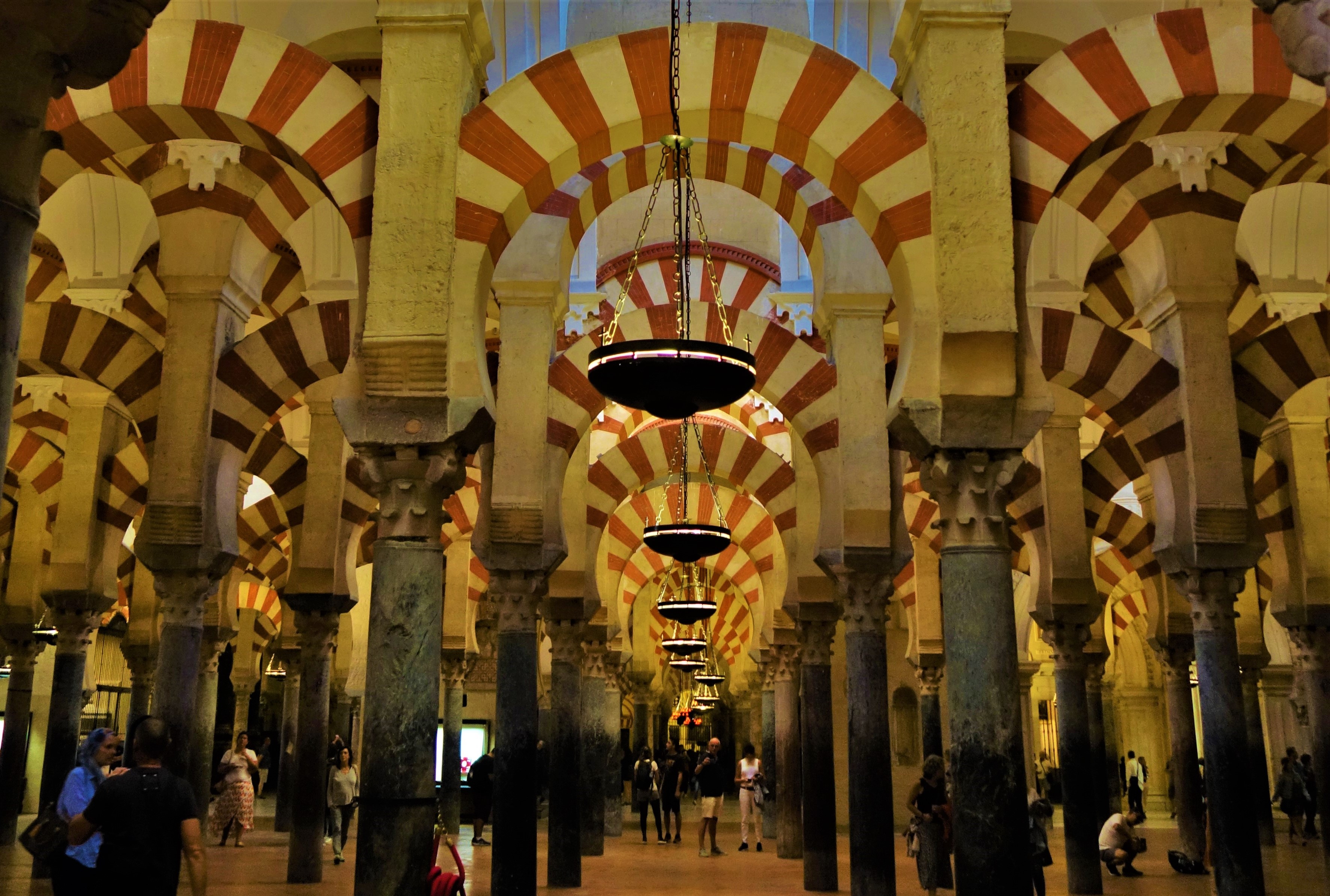
Mezquita-Catedral de Córdoba is the top attraction in Cordoba. The Great Mosque known as as the Mezquita, was originally built by Abd. Ar-Rahman, who was a great believer in religious tolerance. It is interesting to know that few hundred years later, chapels and a cathedral was added and build within the mosque. Listed as a UNESCO World Heritage site since 1984, it was what convinced me to visit Cordoba during my travel in Spain in the first place.

Madrid is the capital city and largest city of Spain. From grand palaces, lush parks, famous museums, and bustling food market, the city clearly has much to offer to its visitors. Staying a day in Madrid allowed me to discover the charm and history of Madrid.

Andorra is a small landlocked European country which is located between France and Spain. Even though small, the country is much bigger than Monaco. With a population of about 80,000, Andorra is a nice stopover if you're in Barcelona.

Barcelona, the second largest city and Catalonian capital in Spain, is well known for its unique architecture, great Mediterranean weather, excellent food and nightlife. It was the first city I visited during my trip to Spain and what a great start it was.

Palau de la Música Catalana, a concert hall that epitomises Catalan Art Nouveau, was designed by Lluís Domènech i Montaner. It was built during 1905 to 1908 for a choral group named Orfeó Catalá. It was declared by UNESCO as a World Heritage Site in 1997. Although it is still a fully functioning music hall today, it is equally as popular as a tourist attraction with guided tours to view its distinctive and ornamental interior.

Casa Milà is the last building designed by Antoni Gaudí, before he devoted himself completely to the construction of the Sagrada Familia. It was the new home of the Milà family, hence the name. However, it was also known as La Pedrera (the quarry house) due to its irregular shape façade which resembles an open quarry in appearance.
Nestled among Carmel Hill’s north face, Park Güell is another masterpiece by Gaudí which offers sweeping panoramic vistas of Barcelona city below. This impressive park covers a total of 12 hectares. A giant salamander known as “the dragon” greets visitors at the staircase near the main entrance as visitors approaching the terrace. It has become a symbol of Barcelona along with Sagrada La Familia.

La Rambla is the most famous street in Barcelona. Lined by plane trees on both sides, it stretches for approximately 1.2km from Place de Catalunya at the northern end to Port Vell and Columbus Monument at the southern end. The ever crowded and lively Mercat de Sant Josep de la Boqueria is well worth a visit while strolling along La Rambla.

Palau Güell is one of Antoni Gaudi's early works in Barcelona (1886 - 1890). It was the home of the Güell i López family on La Rambla until they moved to Park Güell. It is now part of UNESCO World Heritage Site "Works of Gaudi".

Casa Batlló is one of Antoni Gaudi's famous works in Barcelona, redesigned by him in 1904. This distinctive building on the Passeig de Gràcia immediately caught my attention with its skeletal and colourful mosaic facade. It was the first place I visited on my second day in Barcelona.

Sagrada Familia is the genius architect, Antoni Gaudi's most well known work and it has become the symbol of Barcelona. Its construction began in 1882 and is expected to be completed by 2026. Gaudi managed to complete the crypt and the Nativity Facade during his lifetime, which have been declared a UNESCO World Heritage site together with six other Gaudi buildings in Barcelona.





![[JAPAN] 6D5N Amazing Kansai Itinerary (Wakayama, Osaka, Nara, Kobe & Kyoto)](https://blogger.googleusercontent.com/img/b/R29vZ2xl/AVvXsEi2UK0e3s9-Gu8sThwL7dvNKbHojNH6iikXab7ss4Uf_gyzV7LK88LfFu1to5IMLfI7lpKCAtwbsA0yMJCCCJiYK2Mf6FHQcfqIjLBFER4esBKOEG-qHOP-CeRqUcQodGaot3gBNoxVnizq/s72-c/?imgmax=800)

![[MONACO] How To Visit Monaco In One Day From Nice](https://blogger.googleusercontent.com/img/b/R29vZ2xl/AVvXsEgZkJeVAOmz4LTRwY2uDTK131UJVUWH_44GUUU3H-ni63dK2BlNqITBIh5Tdcpz9kXTUb7ePW7f-PQ1Y7E6B4lnqKEHs_nL3Eop-ouoFhxayMI4lNCcUG-oJnGMVwpGDlBu8lfgn10H_QHw/s72-c/DSC06605.JPG)


![[NETHERLANDS] OBA Library – Best Kept Secret of Amsterdam](https://blogger.googleusercontent.com/img/b/R29vZ2xl/AVvXsEiDyiyIO9JViz30aNnbSdvvZ5ttXpJ-p_9tN-KiY04xpzUoI-beA0jf5yS25SVrJq2BnwUT11NZT4OyK7_WB-1pjpxzQ0y0NvCR17EbUL8SHIhiODGcjAkLtI-1r57bUNoMyGogCD_3nsCC/s72-c/?imgmax=800)