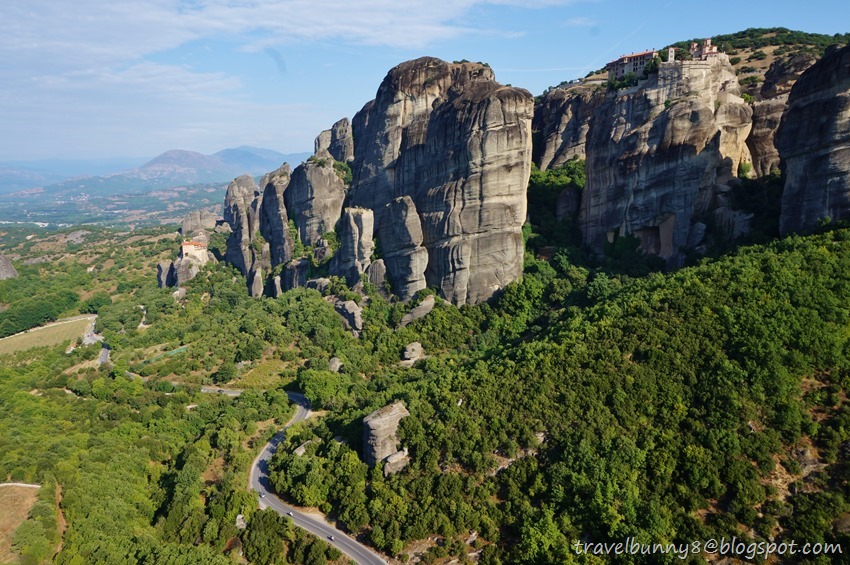
Meteora literally means “middle of the sky” or “suspended in the air” in Greek. A visit to the Meteora monasteries is an awe-aspiring experience to say the very least. Meteora encompasses an entire rock community of a total of 24 monasteries. Only 6 monasteries remains today. Those days, there were no steps and the main access to the monasteries was by means of a net that was hitched over hook and hoisted up by rope or on retractable wooden ladders. Meteora is included on the UNESCO Heritage List.

Kalampaka (also called Kalambaka or Kalabaka) is a town of 12,000 population which is situated at right at the foot of the Meteora rocks. This is where most visitors stay to visit the Meteora rocks. But it is much more than a town with impressive Meteora pinnacles at the background. Kalampaka has rich and long history. A Greek inscription on the wall of one of the town’s oldest churches (St. John the Baptist) testifies the existence of an ancient Greek settlement under the name Aiginion.

Most people would have no idea where Thermopylae is. But if I mention this is the site where the Greeks held the narrow pass for 3 days with Spartan King Leonidas fighting with the Persians in the Hollywood movie “300”, then perhaps you’ll have a better idea where Thermopylae is. Although the Persians eventually took control of the pass, the heroic defeat of King Leonidas became a legend.

In ancient times, Delphi was considered the center of the known world by the Greeks. Kings, warriors and philosophers visited Delphi and the famous Pythia, the prophetess, anticipating an oracle about their future. Today it is a UNESCO World Heritage Site. Its ancient ruins set against the magnificent Mount Parnassus makes it one of the highlights of my Greece trip.
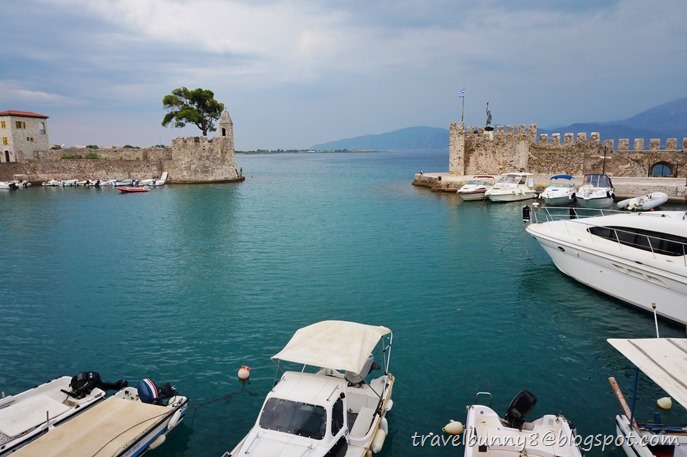
Nafpaktos is a small and lovely town situated on a bay on the north coast of the Gulf of Corinth. It has a relaxing atmosphere. Historically, it is famous for the Battle of Lepanto that took place here in 1571. The port and castle are the main attraction of the town.

Olympia is one of the most well known tourist destination in Greece. The Olympic Games were held in Olympia every four years beginning in 776 BC. It was also a center for worship of Zeus during the 10th century BC. The Olympic Games were held as a sacred truce concluded by three kings of Elis, Sparta and Pisa. It ensured the cessation of hostilities and a suspension of executions for the duration of the games.
The Archeological Site of Olympia is inscribed in the UNESCO World Heritage Site.

Mycenae, built between two hills, Profitis Ilias and Sara, dominates the Plain of Argos. The citadel of Mycenae is the most impressive creation of Mycenaean architecture. It served as seat of the administration of the realm and of its various activities. The fortified area occupied a surface of 30,000 sq. m.

Epidaurus is among the most important ancient sites of Greece. It is located only 2 hours drive from Athens. In ancient times, Epidaurus was famous for the Asklepion, a center for healing. The name of Asklepion is derived from the god of healing, Asklepius (also the son of Apollo).

There are two official sales per year in Greece: summer and winter. In summer, sales starts from mid July till end of August. In winter, sales starts from mid January to February. I was visiting Greece early August 2015. So it was the best time to shop for me. Just like any other big cities and tourist attraction, Athens has quite a few popular places for shopping among the tourists and Athenians. One of the best places to buy just about anything is Monastiraki Flea Market and Ermou Street.

The excavation of ancient Athenian agora has been excavated since 1931. It revealed a large number of temples, stores, altars and even a concert hall. Today, two large buildings are intact: the Hephaisteion and the Stoa. The Hephaisteion is the best preserved temple in Greece and the Stoa was a large shopping center which is now a museum.

Cape Sounion is located at approximately 65 km south-east of Athens. It is famous as the site of ancient ruins of the Temple of Poseidon. Since it is not too far from Athens, I decided to have a half-day excursion to Temple of Poseidon in the noon.

Rising up about 156m from the basin of Athens is the Acropolis of Athens. Acropolis in Greek means highest city. This 5th Century BC ancient Greek monumental complex is a UNESCO World Heritage Site and is definitely the most famous attraction in Greece.

Athens, the capital and largest city of Greece is known to the world as the cradle of western civilization and the birthplace of democracy.

Santorini is a flooded caldera with a long, steep, multicoloured arc of cliffs. The unique view of white buildings sitting on top on of the cliff like a layer of snow makes it one of Greece’s most scenic island.

A sea trip around Santorini’s caldera, taking in the cliff face sights from sea level is one of the recommended activity to do while visiting this beautiful island. You can also do a little scuba diving while you’re at the sea.

Nea Kameni which means ‘New Burnt’ is a volcano located inside the caldera of Santorini. So it's basically a smaller volcano inside a bigger volcano. This new volcano only started to emerge from the sea about 300 years ago. The eruption that occurred from 1701 – 1711 must be a spectacular view for the inhabitants of Santorini at that time.

Fira is the main town of Santorini. Its central location makes it a main hub for transportation, complete with a bus and taxi station, cable car station that connects to the old port at the bottom of volcano cliff. It also has the island’s largest shopping center and the biggest choice of dining and entertainment.

Oia is the most famous town on Santorini, known for its breathtaking sunset and its charming white wash buildings and blue domed churches. The town extends for almost 2 km along the northern edge of the caldera. Built on the steep cliff overlooking the Aegean sea, its romantic ambience, especially during the sunset time made it a honeymoon destination too.

Santorini or Thira is a famous Greek island located in the southern Aegean Sea. It was the core of an ancient volcano that erupted in about 1640 – 1620 BC. A large part of it collapsed after an enormous volcanic eruption, creating the current caldera. Today I’m going for a round-island tour to visit various attractions in Santorini including Wine Museum, Prehistoric town of Akrotiri, Red Beach, lighthouse, Firostefani, Imerovigli and lastly stop at Oia where I’ll be spending the night.
Follow Me @Instagram





![[JAPAN] 6D5N Amazing Kansai Itinerary (Wakayama, Osaka, Nara, Kobe & Kyoto)](https://blogger.googleusercontent.com/img/b/R29vZ2xl/AVvXsEi2UK0e3s9-Gu8sThwL7dvNKbHojNH6iikXab7ss4Uf_gyzV7LK88LfFu1to5IMLfI7lpKCAtwbsA0yMJCCCJiYK2Mf6FHQcfqIjLBFER4esBKOEG-qHOP-CeRqUcQodGaot3gBNoxVnizq/s72-c/?imgmax=800)

![[MONACO] How To Visit Monaco In One Day From Nice](https://blogger.googleusercontent.com/img/b/R29vZ2xl/AVvXsEgZkJeVAOmz4LTRwY2uDTK131UJVUWH_44GUUU3H-ni63dK2BlNqITBIh5Tdcpz9kXTUb7ePW7f-PQ1Y7E6B4lnqKEHs_nL3Eop-ouoFhxayMI4lNCcUG-oJnGMVwpGDlBu8lfgn10H_QHw/s72-c/DSC06605.JPG)
![[NETHERLANDS] OBA Library – Best Kept Secret of Amsterdam](https://blogger.googleusercontent.com/img/b/R29vZ2xl/AVvXsEiDyiyIO9JViz30aNnbSdvvZ5ttXpJ-p_9tN-KiY04xpzUoI-beA0jf5yS25SVrJq2BnwUT11NZT4OyK7_WB-1pjpxzQ0y0NvCR17EbUL8SHIhiODGcjAkLtI-1r57bUNoMyGogCD_3nsCC/s72-c/?imgmax=800)

![[FRANCE] My Favourite Paris Eiffel Tower Photo Spots](https://blogger.googleusercontent.com/img/b/R29vZ2xl/AVvXsEi220KHLfBDpyO53KorHwAb0KQEuiiaVDlrFYwEEAvs8YvKb-Edmyt7Hl7rZszN6qc-GM4e3SmjBS2pUiCiv8ljl8mnrUR93Ljxb0xGrSZ4sZLPRErpbAj29btKvnIC67xV93iKnrH3QRcc/s72-w781-c-h505/DSCF4372.JPG)